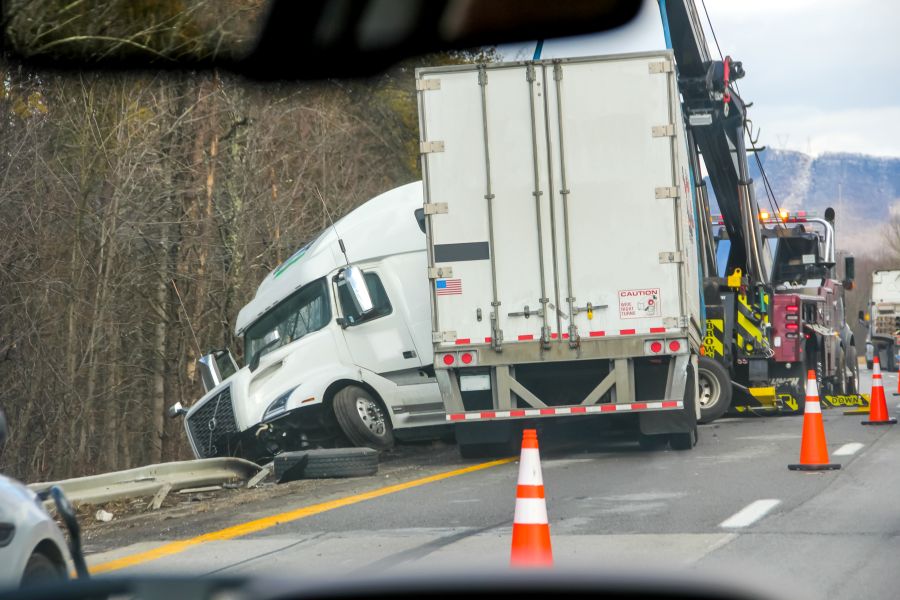

Phoenix sits where Interstate 10 meets Interstate 17, two of the busiest truck routes in the Southwest. Traffic here keeps […]
Phoenix sits where Interstate 10 meets Interstate 17, two of the busiest truck routes in the Southwest. Traffic here keeps growing every year. Every day, thousands of big trucks drive through Maricopa County, carrying freight to California, Texas, and other states.
In 2026, these trucks will carry more than freight. They also carry new technology, like AI dash cams, fleet tracking tools, and engine computers that record what the truck does. If you get hurt in a truck crash, this data matters a lot, because it can help decide if your claim succeeds. That is also why you must act fast, since this kind of data can disappear quickly.
Why a Truck Accident Claim Is Different From a Car Accident Claim
A crash with a regular car is fairly simple under the law, since state law covers most of it. A crash with a big truck is different, because federal rules apply too. These rules come from the Federal Motor Carrier Safety Administration, or FMCSA. They change how a truck accident claim gets built from day one.
In a normal car crash, you usually deal with one driver. A semi-truck crash can be more complex, and several parties may share the blame. This can include the driver, the trucking company, or the company that loaded the cargo. It can include the truck maker, if a part failed. It can even include a freight broker who arranged the job. Each of these parties may carry its own insurance, and each one may try to point the finger at someone else.
Federal law also sets high insurance limits for big trucking companies, much higher than a normal driver’s policy. This affects how settlements get worked out in serious injury cases. Finding out who is at fault, and how much, is often the hardest part of a truck case. A good truck accident claim usually starts with a clear picture of every party involved, not just the driver behind the wheel.
Truck Accidents Are a Real Problem on Arizona Roads
Arizona’s own numbers show why this matters. The Arizona Department of Transportation tracks large truck crashes. In the most recent public report, the state had 9,258 of them. These crashes caused 1,300 injuries and 71 deaths. Most of them happened in Maricopa County, which alone saw 8,005 of these crashes.
Arizona’s Commercial Vehicle Safety Division also studied these crashes and found that about one in four involved a distracted or impaired driver. Many of these crashes happened on interstate highways.
A quick note on this data: it comes from 2019, the newest public data found for this article. Crash patterns can shift over time, so always check current ADOT numbers before using them in a real case.
Driver fatigue comes up again and again in this data, and it is also the main reason the next section matters so much. Tired drivers react slower, and a loaded commercial truck needs much more distance to stop than a regular car.
The Data Trail: Black Boxes, ELDs, and Why Speed Matters
Since 2017, most truck drivers must use an Electronic Logging Device, or ELD for short, which tracks a driver’s hours automatically. It replaced paper logs, which drivers could fake and sometimes did.
After a crash, attorneys often check ELD records first. They want to know if the driver drove too many hours. Federal rules set a limit on driving hours. If a driver went over that limit, it is strong proof of fault. If the trucking company pushed the driver to keep going, the company may share the blame too.
Trucks also carry what people call a black box, which is really a mix of systems, not one single device. One part is the Event Data Recorder, or EDR. It saves a short burst of data from right before a crash. This includes speed, braking, and seatbelt use. Another part is the Engine Control Module, or ECM. It tracks engine data over time and can show hard-braking events from weeks before the crash. This can reveal a pattern of unsafe driving. Many trucks also use GPS tracking and driver-behavior scoring, but the trucking company controls this data, not the driver. Some newer trucks also use forward-facing and cab-facing dash cams, which add video evidence on top of all these numbers.
Here is the problem: this data does not last forever. Some systems erase old records within days. A truck sent back into service can lose its history during routine repairs. Courts have punished companies that destroyed data on purpose, usually once a lawsuit becomes likely. But by then, the damage is already done. That is why you should act fast. Send a written request to save this data right after the crash, not weeks later. This is one of the most important early steps in a truck accident case.
2026’s AI Wave: What Is Really Changing
Trucking technology is moving fast in 2026. Some of it is already changing how fleets handle safety. It is also changing how insurers think about blame.
AI-powered dash cams are a big part of this shift. Older dash cams just record video that you review after a crash, but newer AI systems do more. They can spot risky driving in real time, like following too close or drifting out of a lane. These systems can warn the driver before a crash happens, instead of just filming it. One 2026 industry safety report called this a turning point. Real-time AI warnings are becoming the main way large fleets cut down on crashes.
It helps to know what the law actually requires right now. Automatic Emergency Braking, or AEB for short, is a system that can brake a truck on its own. It can help stop a crash before it even happens. Federal regulators first proposed requiring AEB back in 2023, and as of mid-2026, that rule was still not final. Regulators were working on a new proposal covering how to test these systems, with no final date set. In plain terms, AEB is not required by law yet on trucks already driving Arizona’s highways today.
This still matters for a truck accident case. A trucking company cannot be called negligent today just for skipping AEB, since no rule requires it yet. But the opposite can still be true. Say a company could afford safety technology that was available. Say it chose not to use that technology. That choice can still count as evidence of negligence, even without a government rule. Courts have used this “reasonably careful carrier” idea for years, long before AI entered the picture. AI safety tools are becoming standard on new trucks. Expect more Phoenix truck accident cases to ask one key question: what safety technology could this company have used, and why didn’t it?
Fully self-driving trucks are still years away for most routes, though large carriers plan more test runs in 2026. Regular freight routes will likely wait longer. For now, most Phoenix truck accident claims come down to something simpler. What did the truck’s own cameras, sensors, and logs show in the seconds and days before the crash?
Arizona’s Comparative Negligence Rule
Arizona follows a rule called pure comparative negligence, found in a law called A.R.S. § 12-2505. Under this rule, you can still recover money even if you were partly at fault for the crash. Your total payout just gets reduced by your own share of the blame. There is no point where you lose your right to recover completely.
This rule matters in truck cases because trucking companies often try to shift blame onto the smaller vehicle. They may say you followed too close, changed lanes badly, or braked too hard. This can lower what they have to pay. Strong proof stops this tactic from working. You need solid evidence of what really happened ELD data, ECM data, and dash cam footage pulled before it disappears.
The Clock Is Running: Arizona’s Statute of Limitations
Arizona has a filing deadline for these cases, set by a law called A.R.S. § 12-542. You generally have two years from the crash date to file a lawsuit. After that, you can no longer do so. This deadline keeps running during settlement talks, even though insurance negotiations can drag on for months. Trucking evidence disappears fast, so waiting until close to that two-year mark to get organized is risky.
What To Do After a Phoenix Truck Accident
Every truck accident case is different, but the first few days usually matter the most. Evidence is freshest right after the crash, and some of it starts disappearing almost right away. A few steps can make a big difference in your case:
- Get medical care right away. Do this even if you feel fine at first.
- Make sure the police file a report. Get the report number.
- Take photos of the scene. Photograph the vehicle damage and the road itself.
- Get contact information from witnesses. Do this before they leave.
- Avoid giving a recorded statement to the trucking company’s insurer. Talk to a lawyer first.
- Send a written request to preserve evidence. Do this within days, not weeks. Electronic data can disappear fast, and a trucking company has no reason to save it for you.
About the Author: Jason A. Harris is the founder of Harris Injury Law, PLLC, a Phoenix-based personal injury and workers’ compensation firm. He has practiced law in Arizona since 2006. He is admitted to the State Bar of Arizona and the U.S. District Court of Arizona. He belongs to the Arizona Association for Justice. As a Phoenix truck accident lawyer, his work focuses on motor vehicle crashes, including trucking cases, where early access to ECM, ELD, and dash cam evidence often decides the outcome of a claim.
