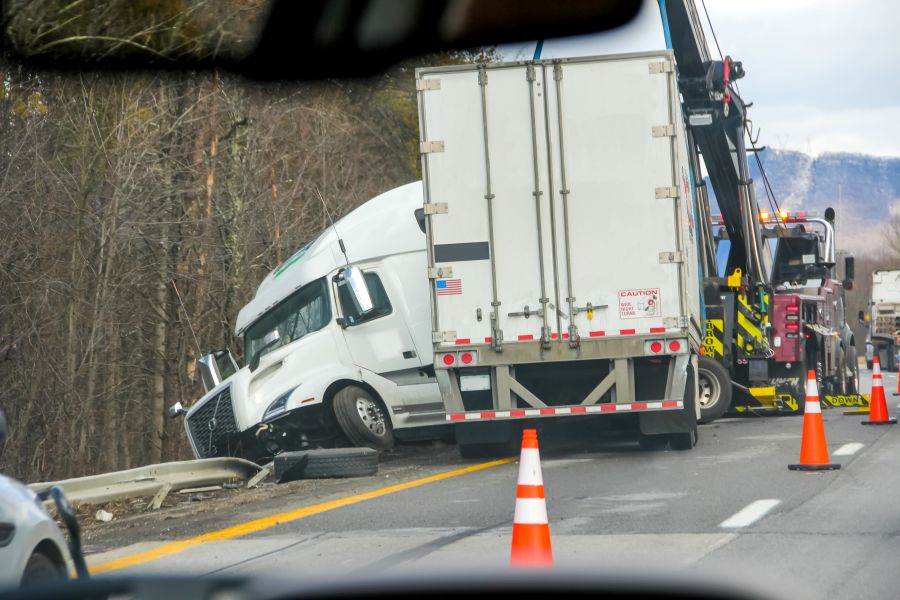

An 80,000 pound tractor-trailer brakes three seconds too late on Interstate 70 near the Stan Musial Veterans Memorial Bridge. Cars […]
An 80,000 pound tractor-trailer brakes three seconds too late on Interstate 70 near the Stan Musial Veterans Memorial Bridge. Cars get crushed. Crews shut down lanes for hours.
St. Louis truck accident claims do not work like ordinary car crash claims. When two cars collide on Kingshighway, officers sketch the scene and insurers swap policy numbers. When a semi is involved, the trucking company sends its own response team, and that team can reach the shoulder before the road reopens.
St. Louis Is a Truck Town
The region is the third largest rail hub in the country and sits on one of the busiest inland ports in the United States. Freight pours through the metro on I-44, I-55, I-64, and I-70, plus the beltways at I-170, I-255, and I-270. Regional studies show I-70, I-170, and I-270 alone carry more than a third of all truck miles driven on urban highways inside St. Louis.
Add the warehouse clusters in Earth City, Hazelwood, and Wentzville, plus the port terminals along the riverfront, and commuters share nearly every lane with heavy trucks. That also means large carriers with defense lawyers already on retainer in Missouri.
What Most Crash Victims Get Wrong
Most drivers expect the truck driver’s insurance to step in and a settlement to follow the usual math. That assumption can end a case before it starts.
Within hours of a wreck on I-55 near the Poplar Street Bridge or on I-44 through south county, corporate safety directors and defense lawyers can be standing at the scene. Their job is to limit what the company pays.
A Missouri State Highway Patrol or St. Louis Metropolitan Police Department report captures the last few seconds before impact. It does not capture the dispatch pressure, the skipped brake job, or how long the driver had been awake. The real fight happens inside memory chips and company servers.
Step 1: Freeze the Data Before It Is Erased
Most heavy trucks carry an Engine Control Module that tracks speed, brake use, engine RPM, seatbelt status, and steering input in the seconds before a crash. That memory does not last. Many systems are overwritten on a rolling cycle, and some records are lost when the engine restarts or the truck gets towed.
Federal rules show how short the window is. Under 49 CFR 395.8, carriers only have to keep hours of service and electronic logging device records for six months. Inspection reports drop off at 90 days.
A spoliation letter goes out fast, to the carrier, its parent company, and its insurers. It demands they preserve:
- Engine Control Module and event recorder data
- Electronic logging device records and hours of service backups
- Dashcam video, forward facing and driver facing
- Inspection reports, repair orders, and work tickets
- Fuel receipts, toll records, and GPS breadcrumbs
- Dispatch messages, load assignments, and the accident register
Missouri courts take evidence destruction seriously. If a company wipes records it knew were relevant, a judge can let the jury assume those records would have hurt the company.
Step 2: Pull the Raw Telematics
Federal law caps how long a commercial driver can stay behind the wheel, but delivery windows set by dispatchers do not always leave room for the required rest. Runs between St. Louis and Kansas City, Springfield, or Cape Girardeau are especially tight.
Skilled investigators go past the summary screen. They subpoena raw satellite telematics, then match GPS pings against weight station stops and diesel receipts. A log may claim a ten hour rest break while fuel timestamps show the same rig still rolling down I-44.
Step 3: Check Maintenance and Weight
A loaded semi needs a lot of room to stop, and deferred brake work stretches that distance. Failures on ramps like the I-64 and I-170 interchange usually trace back to skipped service. Brake defects rank year after year among the top reasons trucks get pulled out of service at roadside inspections.
An independent mechanic should tear down the truck before the carrier repairs or scraps it. Weight matters too. Federal law caps most rigs at 80,000 pounds, and cargo manifests sometimes show a dock crew loaded past that limit.
Step 4: Find Every Company Behind the Truck
One tractor-trailer on I-270 can involve four or five businesses. The driver may be a contractor. The tractor may be leased. The trailer may belong to another logistics firm. The load may have been booked by a freight broker.
Brokers sometimes pick the cheapest carrier available, including carriers with poor safety scores, then claim they only matched a load with a truck. Showing that a broker ignored a carrier’s violation history can open a second insurance policy.
The Missouri Rules That Shape Your Case
Missouri currently allows five years from the date of injury for most personal injury claims under RSMo 516.120, and three years for wrongful death. Bills to shorten that window have moved through Jefferson City in recent sessions, so confirm what applies to your crash date.
Missouri also follows pure comparative fault. An injured driver can recover even when partly to blame, with the award reduced by their share of responsibility. A trucking defense team will push hard to shift as much of that percentage onto you as it can, which is another reason the data matters.
Venue matters as well. Depending on where the crash happened and where the companies do business, a case may belong in the City of St. Louis Circuit Court, the St. Louis County Circuit Court, a St. Charles or Jefferson County court, or federal court in the Eastern District of Missouri. Each option affects timelines, jury pools, and settlement leverage.
Frequently Asked Questions
How long does a trucking company keep black box data after a St. Louis crash? Sometimes only days. Event data can be overwritten when the truck restarts or gets towed, and federal rules require just six months for hours of service records.
How long do I have to file a truck accident lawsuit in Missouri? Five years from the date of injury for most personal injury claims, and three years for wrongful death. Proposals to shorten that deadline have been debated recently.
Can I still recover if I was partly at fault? Yes. Missouri uses pure comparative fault, so your award is reduced by your share of the blame but is not cut off entirely.
Does Missouri limit how much I can recover? Missouri does not cap damages in ordinary negligence cases like truck crashes. Caps apply to medical malpractice claims, which is a different category.
Who else can be sued besides the driver? The motor carrier, the tractor owner, the trailer owner, the shipper who loaded the cargo, and the freight broker. Each may carry separate insurance.
